
- sriamaravati
- Mar 5, 2026
- Construction, Infra
- 0 Comments
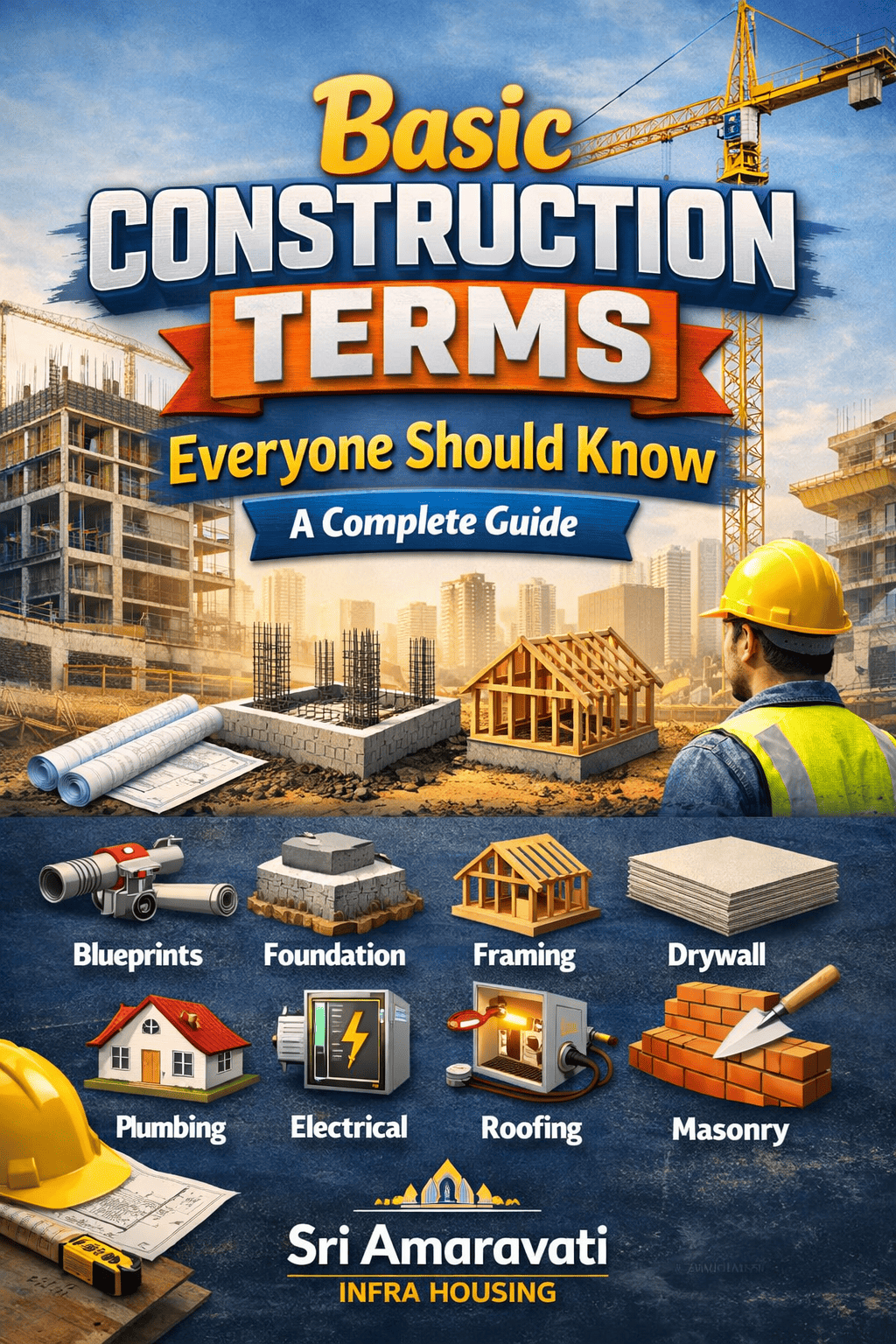
Basic Construction Terms Everyone Should Know
Construction is one of the most complex yet fascinating industries in the world. Whether you are planning to build your dream home, invest in real estate, or simply understand how buildings are constructed, learning the basic construction terms everyone should know can make a huge difference.
When you speak with builders, engineers, architects, or contractors, they often use technical language that may be confusing if you are not familiar with it. Terms like foundation, RCC, slab, beam, curing, plinth level, and formwork are commonly used during construction discussions.
Understanding these terms helps homeowners and property investors make better decisions, avoid costly mistakes, and monitor construction quality.
At Sri Amaravati Infra Housing, experts believe that educating property buyers and homeowners about construction terminology is an important step in creating transparency and trust in the construction process.
In this detailed guide, we will explain 15 essential construction terms in simple language so that anyone can understand them easily.
Why It Is Important to Understand Construction Terminology
Before diving into construction terms, it is important to understand why this knowledge matters.
Construction projects involve multiple professionals such as:
-
Architects
- Structural engineers
- Contractors
- Site supervisors
- Interior designers
- Material suppliers
Each of these professionals uses technical language during discussions and planning.
If you understand the basic construction terms, you can communicate clearly and stay informed throughout the project.
Benefits of Knowing Construction Terms
Learning construction terminology offers several advantages.
1. Better Communication With Contractors
When you know the terms used in construction, you can clearly communicate with builders and contractors without confusion.
2. Better Project Monitoring
Understanding construction terms helps you track progress and ensure work is done correctly.
3. Smarter Budget Planning
Knowledge of construction processes helps you estimate costs more accurately.
4. Avoiding Construction Mistakes
When homeowners understand the basics, they can identify potential issues early.
5. Better Property Investment Decisions
Understanding construction helps investors evaluate building quality before purchasing property.
According to research by the Construction Industry Institute, homeowners who understand construction basics are more likely to manage projects successfully.
Foundation – The Most Important Part of Any Building
The foundation is the lowest portion of a building that directly connects the structure to the ground.
Its main function is to transfer the load of the entire building safely to the soil.
A strong foundation ensures the stability and durability of the structure.
If the foundation is weak, the building may experience problems such as:
- Cracks in walls
- Uneven settlement
- Structural instability
- Water seepage
- Building collapse in extreme cases
Types of Foundations
Different types of foundations are used depending on the soil condition and building size.
Shallow Foundation
Used for small residential buildings where the soil is strong enough to support the load.
Deep Foundation
Used for tall buildings where loads need to be transferred to deeper soil layers.
Raft Foundation
A large concrete slab that spreads the load across the entire building area.
Pile Foundation
Deep concrete or steel columns driven into the soil to support heavy structures.
Plinth Level – The Base Height of the Building
The plinth level refers to the portion of the structure located between ground level and the floor level of the building.
This level acts as a protective barrier against moisture and water infiltration.
Importance of Plinth Level
A properly designed plinth provides several advantages.
- Prevents rainwater from entering the building
- Protects the structure from soil moisture
- Improves building durability
- Enhances structural stability
Builders usually raise the plinth 1.5 to 2 feet above ground level to protect the structure from water damage.
Superstructure – The Visible Portion of the Building
The superstructure refers to everything constructed above the plinth level.
This is the part of the building that people see and use daily.
Components of the Superstructure
The superstructure includes several structural elements such as:
- Walls
- Roof
- Doors
- Windows
- Columns
- Beams
- Slabs
- Staircases
While the foundation provides support from below, the superstructure creates the actual living space.
Beam – A Key Structural Support Element
A beam is a horizontal structural component designed to carry loads from slabs and transfer them to columns.
Beams are extremely important in modern construction because they provide structural strength and load distribution.
Functions of Beams
Beams serve several critical purposes in buildings.
- Transfer loads to columns
- Provide structural stability
- Prevent bending or deformation
- Support floors and roofs
Types of Beams
Common types include:
- RCC beams
- Steel beams
- Wooden beams
- Pre-stressed beams
Most modern buildings use reinforced concrete beams because they are strong and durable.
Column – Vertical Structural Support
A column is a vertical structural element that transfers loads from beams and slabs down to the foundation.
Columns are critical because they support the entire weight of the structure.
Without columns, large buildings would collapse under their own weight.
Types of Columns
Columns can be constructed using different materials.
RCC Columns
The most common type used in residential construction.
Steel Columns
Used mainly in commercial and industrial buildings.
Composite Columns
Combination of steel and concrete for extra strength.
Proper column placement is essential for building stability and safety.
Slab – The Floor and Roof Surface
A slab is a flat horizontal surface made of reinforced concrete.
Slabs are used to form floors and roofs in buildings.
They distribute loads evenly across the structure and provide usable floor space.
Types of Slabs
One-Way Slab
Used in smaller rooms where load moves in one direction.
Two-Way Slab
Used in larger areas where load distribution occurs in two directions.
Flat Slab
Used in commercial buildings where beams are minimized.
Slabs must be properly designed to ensure strength and load distribution.
Mortar – The Binding Material
Mortar is a mixture used to bind bricks, stones, or blocks together in masonry construction.
Components of Mortar
Mortar usually consists of three ingredients.
- Cement
- Sand
- Water
When mixed correctly, mortar creates a strong bond between masonry units.
Importance of Mortar
Mortar plays several roles in construction.
- Holds bricks together
- Distributes loads evenly
- Prevents air and water penetration
- Improves structural stability
Concrete – The Backbone of Modern Construction
Concrete is the most widely used construction material in the world.
It is made by mixing four primary ingredients.
- Cement
- Sand
- Aggregate
- Water
When this mixture hardens, it becomes extremely strong and durable.
Types of Concrete
Plain Cement Concrete (PCC)
Used for flooring and foundation base layers.
Reinforced Cement Concrete (RCC)
Concrete combined with steel bars to increase strength.
Prestressed Concrete
Used in bridges and large buildings where additional strength is needed.
Concrete is valued for its strength, durability, and versatility.
Reinforcement – Strengthening Concrete Structures
Concrete is strong in compression but weak in tension.
To overcome this weakness, steel reinforcement bars (rebars) are embedded inside concrete.
This process is called reinforcement.
Advantages of Reinforcement
Reinforcement provides several benefits.
- Prevents structural cracking
- Improves load-bearing capacity
- Increases durability
- Enhances earthquake resistance
Reinforced structures are commonly known as RCC structures.
Lintel – Support Above Openings
A lintel is a horizontal structural element placed above doors and windows.
It supports the wall above the opening and distributes the load safely.
Without lintels, walls above doors and windows could collapse.
Types of Lintels
Common types include:
- RCC lintels
- Steel lintels
- Wooden lintels
- Stone lintels
In modern construction, RCC lintels are the most commonly used.
Curing – Strengthening Concrete After Pouring
Curing is the process of maintaining moisture in concrete after it has been poured.
This helps the concrete gain maximum strength.
Why Curing Is Important
Curing is critical for several reasons.
- Prevents cracks
- Improves durability
- Increases compressive strength
- Ensures proper chemical reaction in cement
Concrete usually requires 7 to 28 days of curing depending on weather conditions.
Formwork – Temporary Mold for Concrete
Formwork is a temporary structure used to hold wet concrete in the desired shape until it hardens.
Without formwork, concrete cannot maintain the required shape.
Types of Formwork
Common formwork materials include:
- Timber formwork
- Steel formwork
- Aluminum formwork
- Plastic formwork
Proper formwork ensures accurate dimensions and smooth surfaces.
Scaffolding – Temporary Construction Support
Scaffolding is a temporary structure used by workers to perform construction tasks at height.
It provides a safe working platform during building construction or maintenance.
Advantages of Scaffolding
Scaffolding improves construction efficiency by:
- Providing safe access to high areas
- Supporting workers and materials
- Reducing construction risks
Safety measures must always be followed when using scaffolding.
Flooring – Final Surface of the Building
Flooring refers to the finishing layer applied on floors after structural work is complete.
Flooring enhances both appearance and comfort.
Popular Flooring Materials
Some commonly used flooring materials include:
- Ceramic tiles
- Marble
- Granite
- Vinyl
- Wooden flooring
Choosing the right flooring improves the aesthetic appeal and durability of interiors.
Finishing – Final Stage of Construction
Finishing is the last stage of construction where the building is prepared for occupancy.
This stage focuses on improving the building’s appearance and usability.
Common Finishing Works
Finishing work includes several activities.
- Painting
- Plastering
- Electrical installation
- Plumbing fixtures
- Interior design
High-quality finishing increases property value and visual appeal.
FAQs – Basic Construction Terms Everyone Should Know
Why should homeowners learn construction terms?
Learning construction terms helps homeowners communicate effectively with contractors and monitor project progress.
What is the most important part of a building?
The foundation is the most important part because it supports the entire structure.
What is the difference between cement and concrete?
Cement is a binding material, while concrete is a mixture of cement, sand, aggregates, and water.
What does RCC mean?
RCC stands for Reinforced Cement Concrete, which combines steel reinforcement with concrete.
Why is curing necessary?
Curing ensures concrete gains strength and prevents cracks.
Conclusion
Understanding the basic construction terms everyone should know is extremely valuable for homeowners, property buyers, and real estate investors.
Construction projects involve complex processes, but learning these key terms makes it easier to communicate with engineers, contractors, and builders.
Companies like Sri Amaravati Infra Housing emphasize educating clients about construction practices so that they can make informed decisions when building or purchasing property.
Whether you are planning to build your dream home or simply exploring the construction industry, understanding these basic concepts will help you navigate building projects with confidence and clarity.